

Best Natural Tallow Balm for Hiking: 2026 Guide
Table of Contents
- Why Hikers Need a Tallow Balm, Not Another Lotion
- How to Prevent Windburn While Hiking Above Treeline
- How to Treat Wind Chapped Skin on the Trail and After
- Natural Barrier Protection for Hikers: What to Look For
- Tallow Balm for Sensitive Skin and Cold-Weather Reactions
- How to Apply Tallow Balm on a Hike (Step by Step)
- Choosing the Right Balm Consistency for Your Pack and Climate
- Conclusion: Pack the Balm That Earns Its Weight
- Frequently Asked Questions
Last Updated: October 2, 2026
Why Hikers Need a Tallow Balm, Not Another Lotion
If you have finished a ridge climb with skin that felt tight, raw, and wind-scoured, you know why the best natural tallow balm for hiking has become standard kit. At WAVE + SUMMIT, we built our first balm after a stretch of extreme weather in the New Hampshire White Mountains, where summit winds and sudden temperature swings stripped moisture faster than any lotion could replace.
American Academy of Dermatology guidance on winter skin care
What Makes Tallow Different from Water-Based Moisturizers
The difference comes down to water content and fatty acid profile. A typical body lotion is roughly 60 to 80 percent water, so it needs emulsifiers and preservatives to stay shelf-stable. Tallow is a dense, semi-solid fat rich in oleic, stearic, and palmitic acids, the same building blocks found in human sebum.
The Fatty Acids That Rebuild a Cracked Skin Barrier
Your skin barrier is a lipid matrix, and cold, wind, and low humidity break it apart. When it fails, water escapes through trans-epidermal water loss, producing the tight, stinging feeling hikers know well.
How to Prevent Windburn While Hiking Above Treeline
Prevention beats treatment, and the window to act is narrow. Apply your balm before you leave the car, not after your face already stings.
- Apply a thin layer to face, lips, ears, and the backs of hands before you start climbing
- Reapply at every transition, such as leaving the trees or turning into the wind
- Cover skin with a buff or hood rather than relying on balm alone
- Avoid licking your lips, which accelerates chapping
How to Treat Wind Chapped Skin on the Trail and After
Once chapping sets in, your goal shifts from protection to repair. Clean the area gently, pat it dry, and apply balm while skin is still slightly damp, locking hydration in rather than sealing over dry, cracked skin.
Natural Barrier Protection for Hikers: What to Look For
A hiking balm has to survive temperature swings, sit in a pack for weeks, and still perform at the summit. That rules out many products sold as natural skincare.
Ingredients That Matter (and What to Skip)
Start with the base fat. Grass-fed tallow should be the first ingredient, not a token amount at the bottom of the list. Then look for oils that add spreadability and vitamins.
Ingredients worth having:
- Grass-fed beef tallow for barrier repair and fatty acids
- Jojoba oil, which is technically a wax ester and closely matches human sebum
- Sweet almond oil for emollient glide and vitamin E
- Beeswax to firm the texture and help it hold up in a warm pack
- Vitamin E as an antioxidant that also extends shelf life
Grass-Fed vs. Grain-Fed Tallow: Does It Change Performance?
Grass-fed tallow generally carries a better fatty acid profile. Grain-fed tallow still moisturizes, but it tends to be softer and less consistent.
| Feature | Grass-Fed Tallow | Grain-Fed Tallow |
|---|---|---|
| Fatty acid profile | Higher CLA, better omega ratio | Lower CLA, more omega-6 |
| Texture | Firmer, more consistent | Softer, varies more |
| Vitamin content | Naturally higher in A, D, E, K | Lower and less consistent |
| Best for | Cold-weather barrier protection | General everyday moisture |
Tallow Balm for Sensitive Skin and Cold-Weather Reactions
Cold weather triggers flushing, tightness, and stinging in people who never react to anything in summer. On the trail, those reactions stack with sweat, sunscreen, and wind, so a balm that works at home can still sting at the summit. Fragrance is usually the culprit, not the tallow itself.
Why Hiking Triggers Reactions That Indoor Skin Never Sees
Three trail-specific stressors drive most cold-weather skin reactions:
- Wind-driven evaporation. Above treeline, wind strips the lipid layer faster than it can rebuild, leaving skin raw and reactive.
- Sweat and salt. Dried sweat leaves salt crystals on skin that abrade the barrier with every turn of the head or swing of the arms.
- Sunscreen layering. Many hikers apply chemical sunscreen and then a balm on top, which can trap irritants against the skin instead of letting them dissipate.
A common pattern is to blame the balm when the real trigger is the combination. Switching to an unscented balm and applying it before sunscreen, not after, resolves most of these cases.
What to Look For in a Sensitive-Skin Hiking Balm
Tallow is unlikely to clog pores the way heavy occlusive balms can. If your skin is reactive, start with an unscented formula and check for these markers:
- Grass-fed tallow as the first ingredient, not a token amount
- Jojoba oil, which is technically a wax ester and closely matches human sebum
- Sweet almond oil for emollient glide and vitamin E
- Beeswax to firm the texture and help it hold up in a warm pack
- Vitamin E as an antioxidant that also extends shelf life
Patch Testing Before a Cold Hike
Patch test on your inner forearm for two days before committing it to your face on a cold hike. If you are testing a new balm on a trip, do it on a short local walk first, not a full-day above-treeline push.
When to Stop Using a Balm on the Trail
If skin is cracked enough to bleed or sting sharply, keep the routine simple: gentle cleansing, balm, and time. Skip exfoliating acids and anything fragranced until the barrier recovers. If a reaction spreads or worsens despite stopping the product, see a clinician rather than layering more balm.
How to Apply Tallow Balm on a Hike (Step by Step)
Total time: 2 minutes Difficulty: Beginner
- Start clean. Wipe away sweat, sunscreen, and grit with a damp cloth or water.
- Warm a pea-sized amount between your fingertips. Tallow softens quickly at body temperature.
- Press, do not rub. Pat the balm into cheeks, nose, lips, ears, and the backs of your hands.
- Layer thin. A little goes far. Add a second pass only where skin still feels tight.
- Reapply at transitions. Every time you leave the tree line or turn into the wind, add another light layer.
- Finish with coverage. Pull up your hood or buff over the balm to hold it in place.
Expected result: Skin that stays supple and sting-free through a full day above treeline.
Choosing the Right Balm Consistency for Your Pack and Climate
Consistency is the most overlooked spec in natural skincare, and it matters most for hikers. Tallow melts near body temperature, so a balm that feels perfect at home can liquefy in a hot car or stiffen into a brick in a winter pack.
Why Tallow Balm Changes Texture with Temperature
Beef tallow is a blend of triglycerides with a melting range close to skin temperature, which is why it spreads so well on contact and why it is vulnerable to ambient heat. Beeswax raises the finished balm's melting point, so firmer formulas hold their shape in a warm pack; the trade-off is more drag on cold skin and a slower warm-up between your fingertips.
Matching Texture to Season and Terrain
| Consistency | Melting Behavior | Best For |
|---|---|---|
| Whipped | Soft, melts fast, can liquefy above roughly 90°F | Summer hikes, quick reapplication, low-elevation trips |
| Standard balm | Semi-solid, holds shape at room temperature | Three-season hiking, everyday use, most packs |
| Firm balm | High beeswax, slow to melt, resists softening | Winter summits, hot climates, long trips, extended storage |
Pack Stability: What Actually Happens in a Hot Car or a Winter Pack
A tin left on a dashboard in August can exceed the melting point of tallow, and once liquefied it may not return to its original texture. It still works, but it may separate and feel grainier. In winter, a balm stored in an unheated pack can be too stiff to spread without warming it against your skin first.
Practical habits that solve both problems:
- Store the tin upright and away from direct sun, ideally in a stuff sack or hip-belt pocket rather than the top of the pack.
- In summer, keep the tin inside a zip bag so any softening does not coat your gear.
- In winter, warm the tin inside a jacket pocket for ten minutes before applying.
- If the balm separates in heat, stir it back together once it cools and it will perform normally.
Travel-Friendly Packaging for a Multi-Day Pack
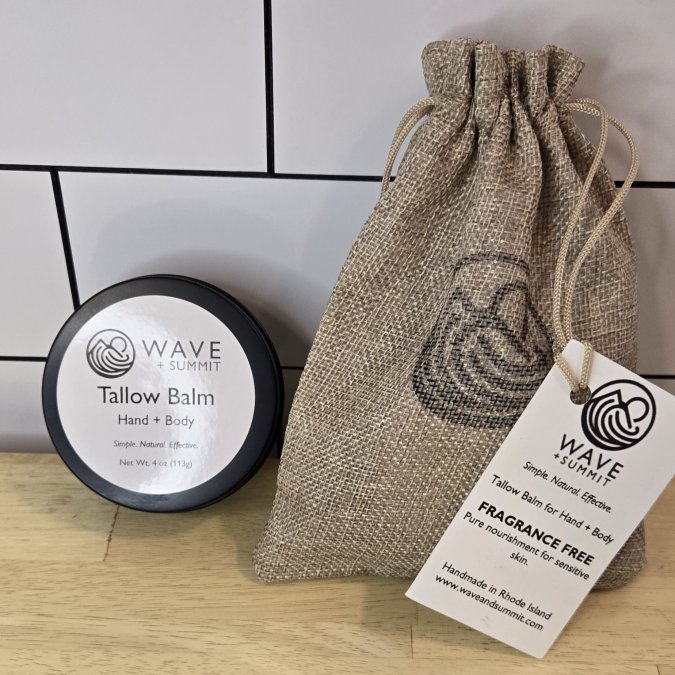
For travel-friendly packing, a 4 oz tin hits a useful middle ground. The WAVE + SUMMIT Sandy Footprints Hand + Body Balm uses that size and works on hands, face, elbows, and heels, so one tin replaces three products. A smaller tin fits a hip-belt pocket for reapplication on the move; a larger tin stays in the pack for camp.

Conclusion: Pack the Balm That Earns Its Weight
Every ounce in a pack has to justify itself, and wind-chapped skin can end a trip faster than a blown knee. The right balm protects before damage starts and repairs what the mountain already took. WAVE + SUMMIT handcrafts biodegradable tallow balms in small batches with grass-fed tallow, jojoba, and sweet almond oil, built for the same extreme White Mountains weather that inspired the first formula.
Frequently Asked Questions
Is tallow balm actually good for your skin?
Tallow contains fatty acids that closely match the lipids in human skin, which helps it absorb without sitting on top like a heavy wax. It also supplies fat-soluble vitamins A, D, E, and K. For hikers dealing with windburn, chapped skin, and trans-epidermal water loss, that combination supports skin barrier repair rather than just adding surface moisture. A well-made tallow balm is non-comedogenic for most people and works as an emollient and occlusive layer against cold, dry air.
How do you treat wind chapped skin after a hike?
Clean the area with lukewarm water and a gentle, fragrance-free cleanser, then pat dry without rubbing. While the skin is still slightly damp, press a thin layer of tallow balm into the chapped areas: cheeks, lips, knuckles, and any spot that cracked. Reapply before bed and again in the morning. Avoid exfoliating or scrubbing the damaged skin, since that slows skin barrier repair. If the skin is bleeding or shows signs of infection, see a doctor.
How do you prevent windburn while hiking?
Apply a tallow balm before you leave the trailhead, not after your face is already red. Cover exposed skin with a balm layer, then add a buff, balaclava, or hood to cut wind exposure. Reapply at exposed ridgelines and on summit pushes. Windburn comes from wind stripping moisture and disrupting the skin barrier, so the goal is a protective layer that stays put through sweat and cold. Hydrate and eat enough, since dehydration makes skin more vulnerable.
What are the disadvantages of tallow balm?
Tallow balm is not for everyone. People who avoid animal-derived ingredients will want a plant-based alternative. Some users find the texture heavier than a lotion, especially in warm weather, and balms can soften in a hot car or pack. Those with a known allergy to beef or dairy should patch-test first. Scented versions may irritate very sensitive skin, so a fragrance-free option is safer for the face. Finally, quality varies widely, so check sourcing and ingredient lists.