

Best Tallow Balm for Dry Skin 2026: What to Look For
Table of Contents
- Why Tallow Balm Works for Dry Skin: The Barrier Basics
- How to Evaluate Any Tallow Balm: 7 Criteria That Matter
- The Best Tallow Balm for Face: Texture, Absorption, and Layering
- Tallow Balm for Sensitive Skin: Patch Testing and What to Avoid
- Tallow Balm vs. Moisturizer: Which Wins for Dry Skin?
- How to Use Tallow Balm for Maximum Moisture Retention
- Common Mistakes When Buying Tallow Balm for Dry Skin
- Frequently Asked Questions
Last Updated: October 5, 2026
Why Tallow Balm Works for Dry Skin: The Barrier Basics
A tallow balm is a water-free moisturizer made from rendered beef fat, and it works for dry skin because its fats closely match the lipids your skin already produces. At WAVE + SUMMIT, our handcrafted tallow balms utilize natural, organic ingredients like grass-fed tallow, jojoba, and sweet almond oil to provide exceptional moisture and reliable barrier protection for your skin.
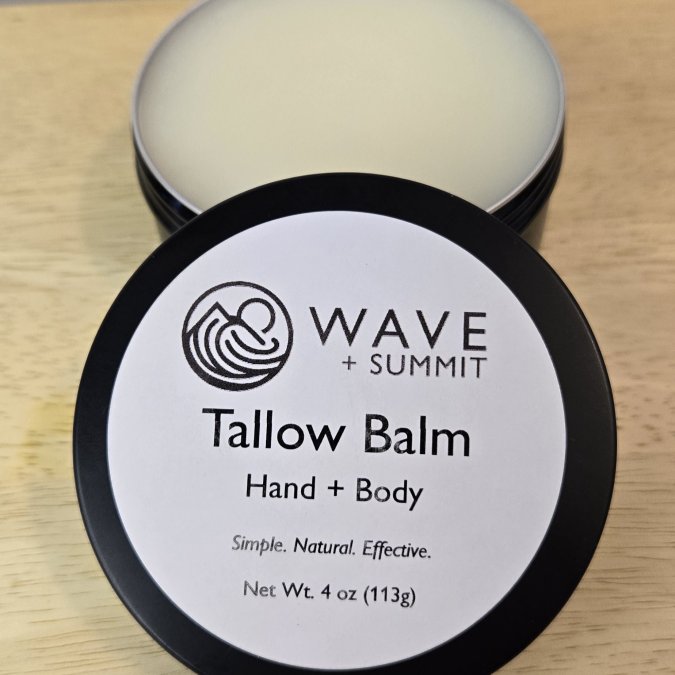
Your skin barrier is a layered mix of ceramides, cholesterol, and fatty acids. When those lipids run low, moisture escapes and irritants get in. Dry, tight, flaky skin is usually a barrier problem, not a hydration problem.
The American Academy of Dermatology's guidance on dry skin makes the same basic point: dry skin improves most when you support the barrier and lock moisture in, not when you strip and re-wet it all day.
How to Evaluate Any Tallow Balm: 7 Criteria That Matter
Most roundups tell you which balm to buy. Fewer tell you how to judge one yourself, which matters because tallow balms are sold by small brands with wildly different sourcing, formulations, and tin sizes.
Score each criterion 1-5, then weight sourcing and ingredients heaviest. A balm that wins on scent and packaging but loses on sourcing is not a good balm, it's good marketing.
- Sourcing (weight: high): Is the tallow grass-fed or grass-finished, and does the brand name a farm, region, or rendering partner? Vague claims like "ethically sourced" score low.
- Ingredient list (weight: high): Short and readable, or a wall of fillers, synthetic preservatives, and undisclosed "fragrance"? Fewer than roughly eight ingredients is a useful rule of thumb, not a hard rule.
- Texture (weight: medium): Whipped and spreadable at room temperature, or hard and waxy straight from the tin? Texture tells you how the fat was rendered and whether it was tempered.
- Absorption (weight: medium): Does it melt into skin within a minute, or leave a heavy film that transfers to clothing?
- Scent (weight: medium): Is there a fragrance-free option for reactive skin, and does any added scent come from essential oils you can identify?
- Packaging (weight: low): Reusable or recyclable tin, a lid that seals, and a size that travels without leaking.
- Value (weight: medium): Price per ounce, not sticker price. A 2 oz. tin at one price and a 4 oz. tin at another are not comparable until you divide.
A common mistake is fixating on the front label and ignoring the back. The ingredient list and the sourcing statement tell you more than any marketing claim. If a brand can't answer "where does your tallow come from," that silence is itself a data point.
Sourcing: Grass-Fed and Grass-Finished
Grass-fed and grass-finished are not the same claim. Grass-fed generally means the animal ate grass for part of its life; grass-finished means it ate grass its entire life. For a tallow balm, grass-finished is the stricter standard, and it usually signals a brand paying closer attention to quality and rendering.
Ask where the fat is rendered and by whom. Traceability matters because tallow is the whole product, there's nowhere to hide a low-quality fat behind water, fillers, or fragrance. If a brand can't tell you the source, treat that as your answer.
Ingredient List: Simple vs. Stuffed
Simple wins for dry, reactive skin. A short list of skin-native lipids, a wax to firm the texture, and a carrier oil or two is plenty. Common carrier oils in tallow balms include jojoba, sweet almond, olive, and avocado, each changes how fast the balm absorbs and how it feels on the face versus the body.
The FDA's consumer guidance on cosmetics and ingredients is a useful reminder that "natural" on a label is a marketing term, not a regulated guarantee. Read the actual ingredients, and treat any undisclosed "fragrance" as a question mark if your skin is reactive.
Texture, Absorption, and Finish: What the Tin Tells You
Texture is the fastest quality signal you can test without reading a label. A well-made tallow balm is plush and buttery, melts on contact, and leaves a soft finish rather than a greasy sheen.
Temperature changes texture, so judge a balm at room temperature, not straight out of a cold mailbox.
Value: Price Per Ounce, Not Sticker Price
Headline prices mislead because tin sizes vary so widely. Divide price by ounces to compare fairly, and factor in whether the brand offers refills or larger sizes. A balm that looks expensive per tin can be the better value per ounce, and a cheap tin can be the worst deal on the shelf once you do the math.
The Best Tallow Balm for Face: Texture, Absorption, and Layering
The best tallow balm for face is one that is fast-absorbing and light enough to layer under makeup or sunscreen.
A well-made tallow balm is plush and buttery, melts on contact, and leaves a soft finish rather than a greasy sheen. Ours is handcrafted with grass-fed tallow, jojoba, and sweet almond oil, and it absorbs without that heavy residue.
For the face, use a micro-dose. A pea-sized amount warmed between fingertips covers your whole face. Press it in; don't rub.
Tallow Balm for Sensitive Skin: Patch Testing and What to Avoid
Tallow balm for sensitive skin comes down to two habits: patch test first, and avoid added fragrance and essential oils until you know your skin tolerates them.
Patch testing is simple and non-negotiable:
- Apply a small amount to your inner forearm.
- Wait 24 hours and check for redness, itching, or bumps.
- If clear, test again on a small patch near your jaw.
- Wait another 24 hours before using it on your full face.
If your skin is reactive, start with a fragrance-free formula. Our Fragrance Free Hand + Body Balm skips added scent entirely for exactly this reason.

Tallow Balm vs. Moisturizer: Which Wins for Dry Skin?
Tallow balm vs. moisturizer isn't a clean win for either, and the honest answer depends on what your skin is missing. The useful distinction is between humectants, emollients, and occlusives, three jobs that water-based lotions and water-free balms split differently.
- Humectants (glycerin, hyaluronic acid, panthenol) pull water into the upper skin layers. They need water in the air or on the skin to work, and in very dry climates they can pull moisture the wrong way if not sealed in.
- Emollients (oils, butters, fatty acids) soften and smooth the surface and fill the gaps between flaking skin cells.
- Occlusives (petrolatum, waxes, and rich fats like tallow) sit on top and slow water loss. This is the raincoat job.
Most lotions are mostly water plus a humectant and a light emollient. A water-free tallow balm is almost entirely emollient and occlusive, so it stays put and keeps working, but it adds little water on its own. That's the trade-off.
| Factor | Tallow Balm | Water-Based Moisturizer |
|---|---|---|
| Base | Water-free fats and waxes | Mostly water |
| Main job | Seal and protect (occlusive + emollient) | Add and hold water (humectant + light emollient) |
| Best for | Dry, chapped, wind-beaten, cracked skin | Mildly dry, normal, or oily skin |
| Finish | Plush, protective, slower to absorb | Light, fast-drying |
| Layering | Over a hydrating serum or damp skin | Under a balm or occlusive |
| Climate fit | Cold, dry, windy, high-altitude | Humid, mild, or oily-skin conditions |
When a Balm Wins
For genuinely dry, chapped, or cracked skin, heels, knuckles, elbows, windburned cheeks, the sealing power of a balm usually does more than a lotion can. If your skin feels tight after moisturizing, or if lotion seems to disappear within an hour, that's a sign you need more occlusion, not more water.
When a Moisturizer Wins
If your skin is oily, acne-prone, or you live somewhere humid, a heavy balm can feel suffocating. In those conditions a water-based moisturizer with a humectant does the job without the film. Balms are not automatically better, they're better for a specific problem.
How to Layer Both
You don't have to choose. The standard approach is water first, oil second: apply a hydrating serum or mist to damp skin, then press balm on top to lock it in. This gives you the humectant's water and the balm's seal in one routine. Applying balm to bone-dry skin skips the hydration step entirely and is one of the most common reasons people find balms underwhelming.
How to Use Tallow Balm for Maximum Moisture Retention
To get the most moisture retention from tallow balm, apply it to slightly damp skin and use less than you think you need. Timing and amount matter more than the brand.
Here's how we'd do it:
- After a shower: pat skin damp, then press balm into hands, elbows, and heels.
- On the face: a pea-sized micro-dose, warmed between fingers, pressed in.
- Under makeup: wait two minutes so it settles, then apply foundation.
- On the trail: a small tin covers lips, knuckles, and windburned cheeks in one pass.
- Before bed: a slightly heavier layer on rough spots overnight.
A 4 oz. tin is compact enough for a pack and lasts through a long trip if you use it as a multi-purpose balm rather than a single-use cream.
Common Mistakes When Buying Tallow Balm for Dry Skin
The biggest mistake is buying on scent and price alone.
Watch for these:
- Chasing the cheapest tin. A grocery-store lip balm and a handcrafted tallow balm are not the same product. Price per ounce tells the real story.
- Ignoring the ingredient list. Fillers, synthetic fragrance, and seed oils can irritate reactive skin.
- Using too much. More balm isn't better; it just sits on top and feels greasy.
- Skipping storage basics. Heat and direct sun can change texture. Keep tins cool and closed.
- Assuming all tallow is equal. Sourcing and rendering change the finished balm.
Climate and season change how much you need. Dry winter air and high-altitude wind call for a heavier layer; humid summers call for less.
Frequently Asked Questions
Which tallow balm is best for dry skin in 2026?
The best tallow balm for dry skin in 2026 is one made from grass-fed, grass-finished tallow with a short ingredient list. Look for added oils like jojoba and sweet almond, plus beeswax for sealing. Wave + Summit's Hand + Body Balm, available in Fragrance Free and Sandy Footprints, uses these exact ingredients and costs $24 for a 4 oz tin. Always patch test first.
Can tallow balm clog pores or cause breakouts?
Tallow balm is unlikely to clog pores for most people because its fatty acid profile is similar to human sebum. However, individual reactions vary. If you are prone to breakouts, choose a fragrance-free version and apply a thin layer. Patch test on your jawline for 24 hours before using it on your whole face.
How often should you apply tallow balm to dry skin?
For very dry skin, apply tallow balm twice daily: once in the morning and once before bed. If your skin is mildly dry, once daily is enough. During harsh winter months or after outdoor exposure, you may need to reapply to hands, face, and lips. A little goes a long way, so start with a pea-sized amount.
Is tallow balm better than regular moisturizer for dry skin?
Tallow balm often outperforms water-based moisturizers for very dry skin because it is water-free and creates a protective seal that reduces moisture loss. Regular moisturizers add water but may evaporate quickly. For best results, apply tallow balm to slightly damp skin to lock in hydration. It also works well as an occlusive layer over your usual serum.
Dry, wind-whipped skin is stubborn, and most drugstore lotions quit on you by mid-afternoon. At WAVE + SUMMIT, we handcraft biodegradable tallow balms with grass-fed tallow, jojoba, and sweet almond oil to deliver deep moisture and reliable barrier protection. Our Fragrance Free and Sandy Footprints Hand + Body Balms come in reusable 4 oz. tins that travel as easily as they sit on your bathroom shelf. Get started with WAVE + SUMMIT and give your skin the barrier support it's been missing.