

Best Primally Pure Alternative for Hikers: 2026 Guide
Table of Contents
- Why Hikers Need a Different Kind of Skincare
- What Makes a Good Primally Pure Alternative for Hikers
- Natural Barrier Repair Cream: Ingredients That Hold Up on the Trail
- Tallow Balm for Hiking: Weight, Space, and Multi-Use Considerations
- Biodegradability and Environmental Footprint: What to Verify
- Climate-Specific Performance: Desert, Alpine, and Coastal Trails
- Common Mistakes When Switching to Natural Skincare for Hiking
- Conclusion
- Frequently Asked Questions
Last Updated: September 30, 2026
Why Hikers Need a Different Kind of Skincare
The best primally pure alternative for hikers is built around tallow, beeswax, and jojoba rather than water-based lotions that evaporate before you reach the switchbacks. Drugstore moisturizers feel fine in the parking lot and useless two hours into a climb, because wind, sweat, altitude, and UV strip the skin barrier faster than any office environment.
What Makes a Good Primally Pure Alternative for Hikers
A good primally pure alternative for hikers is a concentrated, oil-based balm with occlusive ingredients, minimal water content, and packaging that survives a pack. That combination matters more than any single ingredient on the label.
Three criteria do most of the work:
- Occlusion over absorption. The balm should form a light seal, not disappear instantly.
- Few ingredients, clearly listed. Ingredient transparency is the whole point of switching away from mass-market products.
- A tin, not a tube. Tubes crack, leak, and can't be resealed with cold hands.
Sweat Resistance vs. Water Resistance: What Actually Matters
Sweat resistance and water resistance are not the same thing. Water resistance is how a product holds up against rain or immersion; sweat resistance is staying put under the salty film your body produces while working hard.
Here's the practical difference:
| Factor | Water Resistance | Sweat Resistance |
|---|---|---|
| Trigger | Rain, splashes, river crossings | Continuous perspiration |
| Failure mode | Product rinses away | Product migrates into eyes and fabric |
| What helps | Waxes, oils that repel water | Fast-setting balms that bond to skin |
| What hurts | Water-based formulas | Heavy greasy films that slide |
Natural Barrier Repair Cream: Ingredients That Hold Up on the Trail
A natural barrier repair cream for hiking should do one job: replace the lipids your skin loses to wind, cold, and sun. The best ingredients are closest to your skin's own oil composition.
Tallow, Jojoba, and Beeswax: Why These Three Work Together
Tallow, jojoba, and beeswax work together because each covers a weakness in the others. Tallow provides the skin-compatible fatty acids. Jojoba thins the mixture so it spreads instead of dragging. Beeswax firms it up and adds a light protective layer that resists sweat and wind.
Skip any one of them and something suffers:
- No tallow: the balm feels waxy and sits on top of the skin.
- No jojoba: it's too stiff to apply with cold fingers.
- No beeswax: it melts in a hot pack and offers little barrier.
Tallow Balm for Hiking: Weight, Space, and Multi-Use Considerations
A tallow balm for hiking earns its place in your pack only if it replaces at least two other items. Weight and space are the real currency on a long-distance trek, so do the math.
How Much Balm You Actually Use Per Application
A pea-sized amount, roughly 0.02 to 0.03 oz, covers both hands. Lips take a fraction of that, face coverage runs closer to 0.05 oz before a windy summit push, and heels and hot spots take a slightly heavier dab.
Run the numbers for a typical trail day:
- Face, morning and midday: ~0.1 oz
- Hands, two to three applications: ~0.06 oz
- Lips, six to eight touches: ~0.02 oz
- Heels or hot spots, once or twice: ~0.04 oz
Container Format: Tin vs. Tube vs. Stick
Container format is a real decision. Each has trade-offs on the trail:
-
Tin. Resealable, reusable, and hard to crush. The downside is you have to dip a finger in, which is awkward with cold hands or dirty gloves, and cross-contamination between feet and face is a real risk if you're not careful.
-
Tube. Easier to apply one-handed and keeps product cleaner. But tubes crack at the crimp, leak in a hot pack, and can't be resealed once the cap threads strip.
-
Stick. Best for lips and targeted spots, worst for large surface areas like the face or heels. Sticks also tend to be stiffer, which is a problem in cold weather.
-
Chapped lips and windburned cheeks
-
Cracked heels and hot spots on hands
-
Dry cuticles and knuckles after cold mornings
-
A light barrier on the face before a windy summit push
-
A thin layer on chafe-prone areas before a long descent
Biodegradability and Environmental Footprint: What to Verify
Biodegradability claims in skincare are mostly unregulated marketing unless a brand can show third-party verification, so be skeptical of any "eco-friendly" label without backing.
What you can actually check:
- Ingredient lists. Plant oils, waxes, and tallow break down far more readily than silicone-based occlusives or petroleum derivatives.
- Packaging. Reusable tins beat single-use plastic tubes on every measure.
- Certifications. Look for specific, named certifications rather than vague seals. The FTC's Green Guides on environmental marketing claims spell out what brands can and cannot say about biodegradability, and a brand that respects those rules will state its claims precisely.
Climate-Specific Performance: Desert, Alpine, and Coastal Trails
Climate changes which balm works best, which is why some hikers love a product at home and hate it on the trail. The variables that matter most are sweat rate, ambient humidity, and how fast the balm's wax component sets on skin.
Desert and High-UV Environments
Heat and dryness pull moisture from skin fast, and UV exposure accelerates barrier breakdown. In low humidity, sweat evaporates almost as fast as it forms, so the balm isn't washed off, it's dried out and cracked by the same conditions affecting your skin.
What works here:
- A heavier balm with a strong wax component holds up better than a thin lotion because it resists both evaporation and the mechanical abrasion of windblown grit.
- Reapply at midday. Morning application alone won't carry you through a full afternoon of exposed ridgeline.
- Cover the backs of hands and the ears, not just the face. Those are the areas hikers forget and the ones that crack first.
Alpine and Cold-Weather Routes
Cold makes balms stiff and hard to spread, and wind at altitude strips the barrier faster than cold alone. Low humidity, high UV, and constant wind make this the harshest environment most hikers will encounter.
Practical adjustments:
- Warm the tin in your palm or inside a jacket pocket for a minute before applying. Tallow-based formulas soften quickly at body temperature, which is one reason they work well in the cold.
- Apply before you leave camp, not after you've already been exposed. Barrier protection works best before the wind starts, not after skin is already chapped.
- Reapply after any extended stop. A summit push followed by a long break is when windburn sets in.
Coastal and Humid Trails
Humidity means sweat, and sweat means migration. In humid conditions the balm doesn't dry out, it stays soft and mobile, the opposite problem from the desert.
What helps here:
- A lighter application, spread thin, resists running into your eyes better than a thick layer. More product is not better in humidity.
- Apply to dry skin before you start sweating, not mid-climb. A balm applied to dry skin has a chance to bond; one applied mid-sweat just slides.
- Salt spray and wind still strip the barrier, so reapply after any coastal exposure, even if the balm still feels present.
- Choose unscented in humid, bug-heavy areas. Fragrance plus sweat is a reliable way to attract insects.
A Simple Reapplication Rule
Rather than memorizing climate-specific schedules, use one rule: reapply whenever skin feels tight, whenever you stop for more than 15 minutes, and after any exposure to wind, salt, or direct sun. The same balm works across all three climates if you adjust how much you use and how often you reapply.
Common Mistakes When Switching to Natural Skincare for Hiking
The biggest mistake hikers make when switching to natural skincare is expecting it to behave like the water-based lotion they left at home. It won't, and that's the point.
Watch for these:
- Applying to wet skin. Oil and water don't mix. Dry off first, then apply, or the balm slides instead of bonding.
- Using too much. A pea-sized amount covers both hands. Overapplying wastes product and leaves a greasy film that attracts dirt.
- Skipping the face until it's already burned. Barrier protection works best before exposure, not after.
- Buying scented when unscented would do. Fragrance is the most common cause of irritation on already-stressed skin.
- Judging a balm after one use. Tallow-based formulas often feel different on day one than day ten as your skin adjusts.
Conclusion
Switching to a trail-built balm means rethinking how you apply skincare, not just what you carry. The payoff: a lighter pack, fewer products, and skin that holds up through wind, sweat, and altitude.
Frequently Asked Questions
What is the best natural skincare alternative for long-distance hikers?
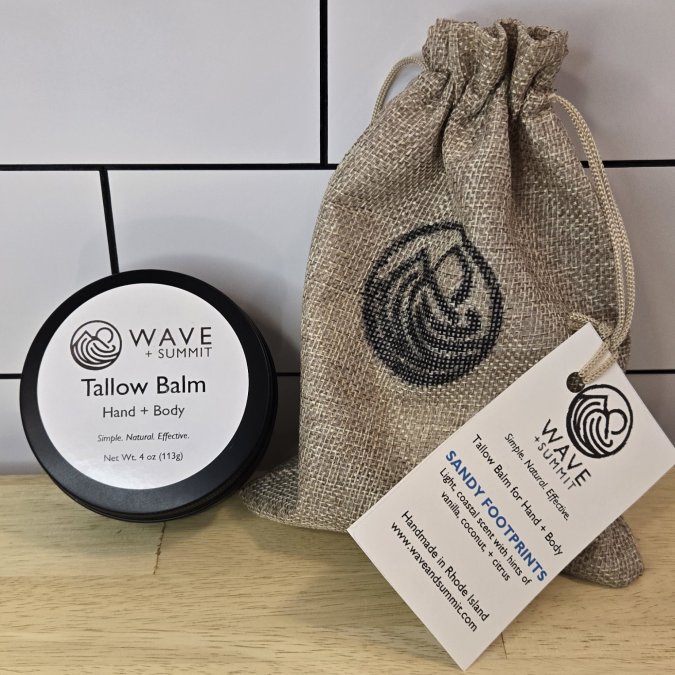
The best option is a multi-purpose balm that replaces lip balm, face moisturizer, and hand cream in one container. Look for grass-fed tallow, jojoba oil, and beeswax, which mimic skin's natural oils and create a breathable barrier. A 4 oz. tin weighing a few ounces can last weeks on trail. Wave + Summit's Hand + Body Balm at $24 fits this profile and comes in a reusable tin.
Is tallow balm better than synthetic creams for trail chafing?
Tallow balm offers advantages for chafing because it absorbs without heavy residue and forms a barrier that reduces friction. Synthetic creams often rely on dimethicone or petrolatum, which can feel greasy and trap sweat. Tallow's fatty acid profile closely matches human sebum, so it absorbs faster. For anti-chafe use, apply a thin layer to friction points before putting on your pack or boots.
What ingredients should hikers look for in a natural barrier repair cream?
Prioritize grass-fed tallow, jojoba oil, sweet almond oil, beeswax, and vitamin E. These ingredients provide moisture, support the skin barrier, and resist sweat breakdown. Avoid products with synthetic fillers, parabens, or artificial fragrances if you have sensitive skin. Fragrance-free options reduce irritation risk in high-exertion conditions where pores open and skin is vulnerable to chafing.
Are there biodegradable skincare options for hikers concerned about the environment?
Yes. Biodegradable balms made with natural ingredients break down without leaving synthetic residue in soil or water. Wave + Summit uses grass-fed tallow, jojoba, sweet almond oil, beeswax, and vitamin E, all of which biodegrade. Packaging matters too: reusable tins reduce waste compared to plastic tubes. Ask brands for ingredient sourcing details and third-party biodegradability documentation if you want proof beyond marketing claims.