

Why Use Grass-Fed Tallow Balm for Skin
Table of Contents
- What Grass-Fed Tallow Balm Is and Why It Matters
- The Nutrient Density and Fatty-Acid Profile of Grass-Fed Beef Tallow
- How Tallow Balm Supports Skin Hydration and the Skin Barrier
- Tallow Balm for Dry Skin: Why It Works Better Than Conventional Moisturizers
- Is Tallow Balm Good for Sensitive Skin
- Does Tallow Balm Clog Pores and Other Common Concerns
- How to Use Tallow Balm on Face and Body
- What Sets Grass-Fed Tallow Balm Apart: Sourcing, Purity, and Environmental Impact
- Frequently Asked Questions
Last Updated: October 5, 2026
What Grass-Fed Tallow Balm Is and Why It Matters
Grass-fed tallow balm is a natural moisturizer made from rendered beef fat sourced from grass-fed cattle, combined with complementary oils and butters to create a protective skin treatment. Unlike conventional moisturizers formulated with synthetic emulsifiers and petroleum derivatives, tallow balm works because its fatty-acid composition closely mirrors your skin's natural lipid barrier.
At WAVE + SUMMIT, we've built our entire skincare philosophy around this principle: the most effective moisturizers aren't the most complex ones, they're the ones that match what your skin already knows how to process.
The reason grass-fed tallow matters specifically is sourcing. Cattle raised on pasture produce fat with a different nutrient profile than grain-fed counterparts. When cows eat grass, their tissues accumulate fat-soluble vitamins and a more favorable balance of essential fatty acids. That translates directly into a more nutrient-dense balm for your skin.
Why use grass-fed tallow balm instead of conventional moisturizers? Because it delivers what your skin actually needs without ingredients your body has to work around. For outdoor enthusiasts, travelers, and anyone dealing with harsh climates or sensitive skin, this distinction shifts everything.
The Nutrient Density and Fatty-Acid Profile of Grass-Fed Beef Tallow
Grass-fed beef tallow is nutrient-dense in ways that most moisturizers simply aren't. The fat from grass-fed cattle contains measurable levels of fat-soluble vitamins, compounds your skin needs but cannot manufacture on its own. These aren't trace amounts; they're present in sufficient concentration to make a real difference in skin health and resilience.
Fat-Soluble Vitamins in Grass-Fed Tallow
Vitamin A in tallow supports cell turnover and helps maintain the structural integrity of your skin's outer layers. Vitamin D contributes to skin barrier function and immune response at the cellular level. Vitamin E acts as an antioxidant, protecting your skin from oxidative stress caused by sun exposure and environmental pollution. Vitamin K supports skin repair.
These vitamins are fat-soluble, meaning they dissolve in fat and are absorbed through fatty tissues. A tallow balm delivers them in a form your skin can actually use. Conventional water-based moisturizers can't carry these nutrients effectively because they're fundamentally incompatible with the product's emulsion structure.
Essential Fatty Acids and Omega Balance
Grass-fed tallow contains oleic acid, a monounsaturated fatty acid that your skin recognizes as a natural component of its own sebum. It also provides linoleic acid and alpha-linolenic acid, omega-6 and omega-3 fatty acids that your skin cannot synthesize internally and must obtain from external sources. The omega-3 to omega-6 ratio in grass-fed tallow is more balanced than in grain-fed beef fat (Fatty Acid Composition of Grain- and Grass-Fed Beef and Their Nutritional Value and...).
These fatty acids don't just sit on the surface. They integrate into your skin's lipid barrier, strengthening it from within. This is why tallow balm users often report that their skin becomes more resilient over time rather than just feeling moisturized in the moment.
How Tallow Balm Supports Skin Hydration and the Skin Barrier
Your skin's barrier is a carefully orchestrated system of lipids, proteins, and water. When that barrier is compromised, by wind, sun, cold, harsh soaps, or chronic skin conditions, your skin loses moisture rapidly and becomes vulnerable to irritation and infection. Conventional moisturizers often try to mask this problem by adding water and humectants that pull moisture from deeper layers. That approach works temporarily but can actually weaken the barrier over time.
Tallow balm works differently. The fatty-acid composition of grass-fed tallow allows it to integrate directly into your barrier structure, filling gaps and reinforcing the lipid matrix. Beeswax, which we include in our formulations, adds another layer of protection by creating a breathable occlusive seal that prevents transepidermal water loss without suffocating your skin.
Skin hydration isn't just about water content. It's about your skin's ability to hold water. A compromised barrier lets moisture escape. A reinforced barrier keeps it in. When you use tallow balm consistently, you're not just adding moisture; you're restoring your skin's capacity to retain it independently.
Tallow Balm for Dry Skin: Why It Works Better Than Conventional Moisturizers
Dry skin happens when your barrier is either too permeable or lacks the lipids needed to maintain its structure. Most commercial moisturizers address this by layering humectants (like glycerin) and emollients (like mineral oil or dimethicone) that sit on the surface and attract water. They feel good immediately.
Grass-fed tallow balm doesn't create that cycle. The fatty acids are compatible with your skin's own lipid structure, so they don't evaporate or wash away easily. They stay, they integrate, and they reinforce your barrier. For people with chronically dry skin, especially those spending time outdoors in cold, wind, or low-humidity environments, this means real relief instead of a temporary fix.
The texture matters too. Tallow balm has a buttery consistency that melts slightly with body heat, allowing it to spread without requiring vigorous rubbing that can damage the barrier further. It absorbs without leaving a heavy, occlusive layer that feels suffocating. This is the balance most dry-skin sufferers are looking for: protection without that trapped, uncomfortable feeling.
Is Tallow Balm Good for Sensitive Skin
Sensitive skin typically means your barrier is already compromised and your skin reacts to many common ingredients. This is where tallow balm shines. The fewer ingredients, the fewer potential triggers. Our Fragrance Free formulation at WAVE + SUMMIT contains only grass-fed tallow, jojoba oil, sweet almond oil, beeswax, and vitamin E, five ingredients, all with long histories of use on human skin.

Tallow itself is hypoallergenic for most people. It's a food product, not a synthetic chemical. Your skin has been encountering tallow in various forms for thousands of years. The risk of an allergic reaction is low, though not zero. Some people with severe dairy or beef sensitivities might react, and those with nut allergies need to be cautious with the sweet almond oil component.
The key is starting slowly. Even with a gentle product, introducing something new to compromised skin requires care. Patch testing, applying a small amount to a discrete area and waiting 24-48 hours, should always precede full-face use.
Does Tallow Balm Clog Pores and Other Common Concerns
This is the question that stops many people from trying tallow balm, and it deserves a straight answer: tallow can clog pores in some people, but it's less likely than with many conventional moisturizers. The reason relates to comedogenicity, a measure of how likely a substance is to block pores.
Tallow has a comedogenic rating of 2 out of 5, which is moderate. For comparison, coconut oil rates 4, mineral oil rates 0, and many silicone-based moisturizers rate 0 to 1. The nuance is that comedogenicity varies by individual.
The second concern, that tallow feels greasy, usually comes from using too much or applying it to already-oily skin. Tallow balm is meant to be used sparingly. A pea-sized amount for your entire face is typically sufficient. Applied this way, it absorbs within minutes and leaves skin feeling nourished, not shiny.
How to Use Tallow Balm on Face and Body
Tallow balm is versatile, but application technique matters. Start with clean, slightly damp skin. Damp skin absorbs moisturizers more effectively because water in the outer layer helps the fatty acids penetrate. Apply a small amount, about the size of a pea for your face, and warm it between your fingers until it softens. Press it gently into your skin rather than rubbing. Let it absorb for a minute before touching anything else.
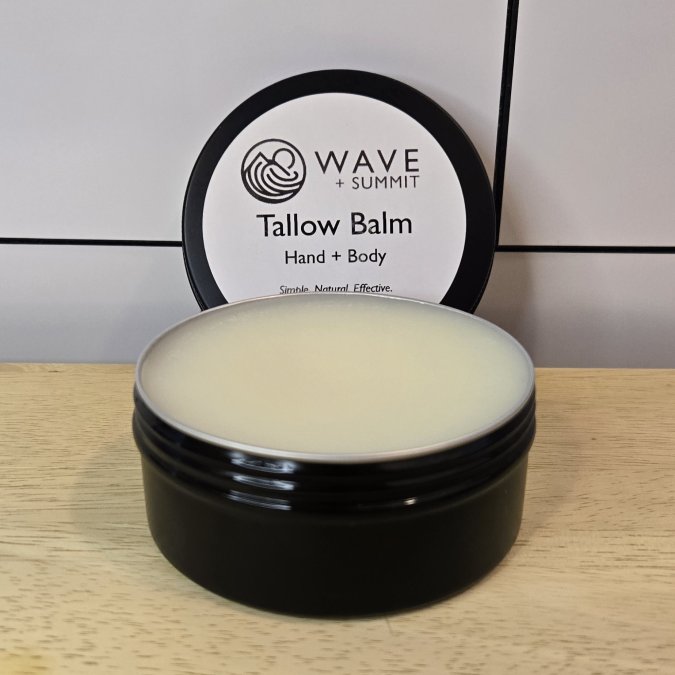
On the body, you can be more generous. Elbows, heels, and rough patches benefit from a thicker application. Many users find that a single tin lasts several months with regular use.
Patch Testing and Application Tips
Before committing to full-face use, apply a small amount to your inner arm or behind your ear and wait 24-48 hours. Watch for redness, itching, or any sign of irritation. This step is especially important if you have sensitive skin or a history of reactions to new products. Even with a gentle ingredient like tallow, individual responses vary.
If patch testing goes well, introduce the balm gradually. Use it every other day for the first week, then daily if your skin tolerates it. Some people experience a brief adjustment period where their skin seems slightly more congested; this often resolves as your barrier strengthens and your skin's natural oil production normalizes.
Choosing the Right Product for Your Needs
If you have sensitive skin or prefer unscented products, a fragrance-free formulation is your safest bet. Our Fragrance Free option at WAVE + SUMMIT contains only the essential ingredients, no added scents that could trigger reactions. If you enjoy fragrance, our Sandy Footprints blend combines tallow with tropical notes inspired by coastal environments, adding a sensory dimension without heavy synthetic perfumes.

The size matters too. A 4 oz tin is compact enough for travel and daily face care, yet substantial enough that you're not replacing it constantly. For hikers and backpackers, this size fits easily into a pack without adding significant weight.
What Sets Grass-Fed Tallow Balm Apart: Sourcing, Purity, and Environmental Impact
Not all tallow balm is created equal. The difference between a product that transforms your skin and one that disappoints often comes down to sourcing and processing. Grass-fed tallow from cattle raised on pasture contains a fundamentally different nutrient profile than tallow from grain-fed cattle.
Rendering quality matters equally. The rendering process removes impurities while preserving the nutrients.
Purity is non-negotiable. A tallow balm should contain tallow, complementary oils, and a minimal amount of natural preservative. Anything else, fillers, synthetic fragrances, emulsifiers, undermines the entire purpose.
The environmental angle is worth considering too. Using the fat from these animals, a byproduct that would otherwise be discarded, represents a more complete use of the resource.
For outdoor enthusiasts and travelers who depend on their skincare to perform in demanding conditions, grass-fed tallow balm offers something that conventional moisturizers rarely deliver: simplicity, effectiveness, and alignment with your values.
Frequently Asked Questions
What makes grass-fed tallow balm different from regular moisturizers?
Grass-fed tallow balm mimics your skin's natural oils more closely than conventional moisturizers, delivering fat-soluble vitamins A, D, E, and K that support skin repair and barrier function. Unlike synthetic moisturizers, tallow contains a fatty-acid profile that matches human sebum, allowing deeper absorption without the heavy, greasy residue. This makes it especially effective for outdoor enthusiasts who need reliable protection against wind, sun, and temperature extremes.
Is tallow balm good for sensitive skin?
Yes, tallow balm is often excellent for sensitive skin because it's a simple, natural ingredient with minimal additives. Grass-fed tallow lacks the synthetic preservatives, fragrances, and emulsifiers that trigger irritation in sensitive skin types. Many people with eczema, rosacea, or reactive skin find tallow balm soothing and nourishing. Always patch test first on a small area of skin before full application, especially if you're new to tallow-based products.
Will tallow balm clog my pores or make my skin feel greasy?
High-quality grass-fed tallow balm typically does not clog pores when applied correctly. Tallow has a comedogenic rating similar to jojoba oil, and its molecular structure allows it to absorb into the skin rather than sit on the surface. The key is using the right amount, a small amount goes a long way. If you experience greasiness, you're likely applying too much. Start with a pea-sized amount and adjust based on your skin's response.
How do I know if a tallow balm product is truly high-quality and grass-fed?
Look for products that disclose their sourcing: grass-fed beef, grass-finished, and ideally from responsible farms without hormones or antibiotics. Check the ingredient list for simple, recognizable components like grass-fed tallow, jojoba oil, sweet almond oil, beeswax, and vitamin E. Avoid products with long lists of synthetic additives or vague sourcing claims. Wave + Summit tallow balms are handcrafted in small batches with transparent sourcing and packaged in reusable, eco-friendly tins, a sign of genuine commitment to quality and sustainability.
Protecting your skin through outdoor adventures doesn't require a complicated routine or products loaded with synthetic compounds. WAVE + SUMMIT's handcrafted tallow balms deliver exceptional moisture and reliable barrier protection using only grass-fed tallow, jojoba, sweet almond oil, beeswax, and vitamin E. Shop the Collection and discover how simple, natural skincare can transform your outdoor experience.